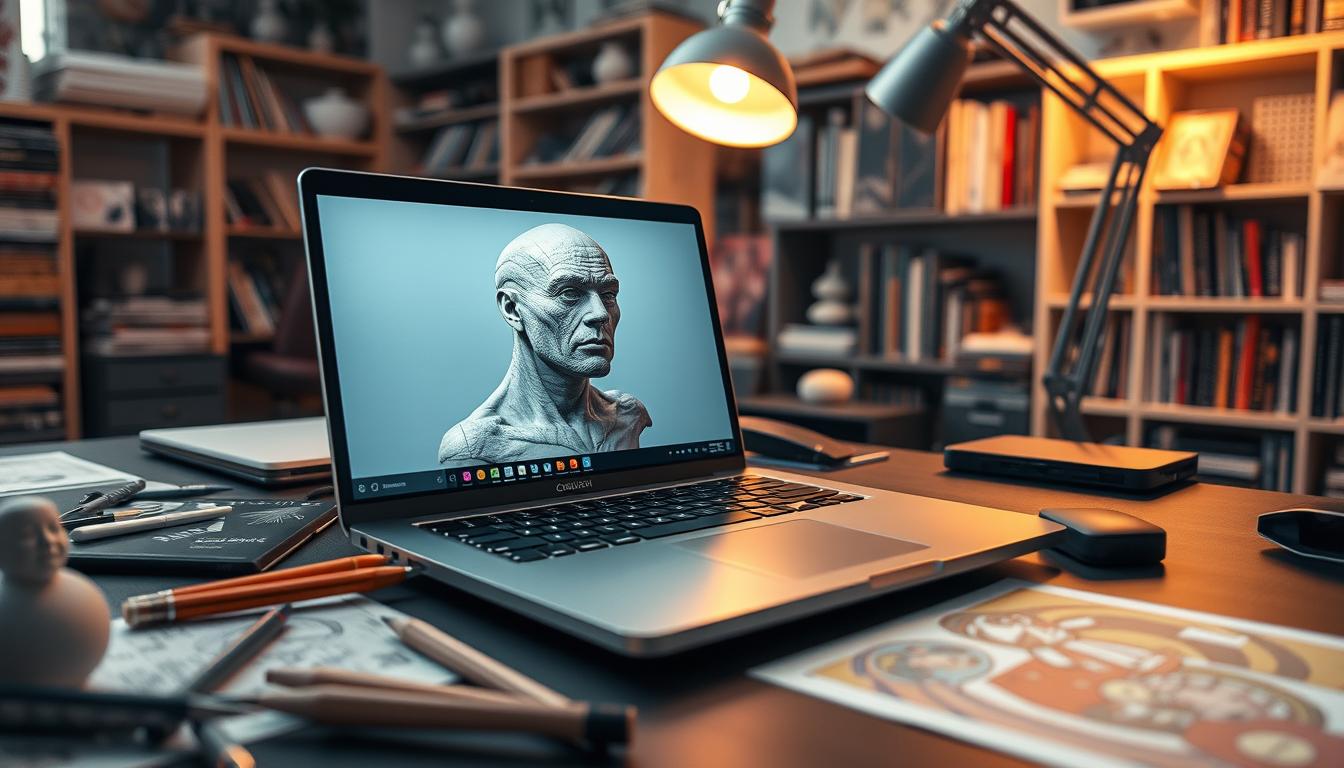
As a professional in the field of 3D modeling and digital sculpting, I understand the importance of having the right hardware to handle demanding tasks like high-poly workflows in ZBrush. The right laptop can make all the difference in delivering high-quality results.
In this article, I will guide you through the best ZBrush laptops that can handle complex 3D modeling tasks. With my experience in technology development and innovation, I will provide you with a comprehensive overview of the laptops that can handle the most complex tasks.
Key Takeaways
- Essential specs for a ZBrush laptop
- Top laptop recommendations for high-poly workflows
- Key features to consider when choosing a laptop
- Performance benchmarks for demanding tasks
- Budget-friendly options for 3D modeling
Why ZBrush Demands Specialized Hardware
Digital sculpting with ZBrush requires more than just a powerful laptop; it demands a deep understanding of the software’s unique hardware requirements. As a complex task, digital sculpting involves handling intricate details and high-poly counts, making it essential to have a laptop that can keep up.
The Unique Challenges of Digital Sculpting
Digital sculpting in ZBrush presents several challenges, primarily due to the high level of detail involved. Artists working with high-poly models need a digital sculpting laptop that can handle the complex geometry and dense meshes without compromising performance. The software’s ability to manage millions of polygons demands not only a robust processor but also sufficient RAM and a capable graphics card.
How High-Poly Workflows Impact Performance
High-poly workflows in ZBrush significantly impact a laptop’s performance. The more detailed the model, the more resources are required to render and manipulate it. This is where a laptop’s specifications become crucial. For high poly modeling, a strong GPU is essential for viewport rendering, while a multi-core CPU helps with processing complex scenes. Adequate RAM ensures that the system can handle large datasets without slowing down.
Understanding these demands is key to selecting the right hardware for your ZBrush workflow, ensuring a smooth and efficient sculpting experience.
ZBrush System Requirements Explained
Understanding ZBrush system requirements is crucial for a seamless digital sculpting experience. ZBrush, a powerful tool for 3D modeling and sculpting, demands specific hardware to function optimally.
Minimum vs. Recommended Specifications
ZBrush has both minimum and recommended system requirements. The minimum requirements include a 64-bit operating system, 8GB of RAM, and a graphics card supporting OpenGL 3.3 or later. However, for a smoother experience, the recommended specifications suggest 32GB of RAM or more and a high-end graphics card.
Requirements for Professional High-Poly Projects
For professional high-poly projects, the requirements are even more stringent. A multi-core processor, ample RAM (64GB or more), and a professional-grade graphics card are essential. A detailed comparison of the minimum, recommended, and professional requirements is outlined in the table below.
| Specification | Minimum | Recommended | Professional |
|---|---|---|---|
| RAM | 8GB | 32GB | 64GB or more |
| Graphics Card | OpenGL 3.3 | High-end GPU | Professional-grade GPU |
| Processor | 64-bit | Multi-core | High-performance multi-core |
Meeting these requirements ensures that ZBrush runs efficiently, allowing artists to focus on their creative work without hardware limitations.
Key Hardware Specifications for Good Laptops for 3D Modeling
To handle demanding 3D modeling tasks, a laptop must be equipped with the right hardware components. The primary factors that influence a laptop’s performance in 3D sculpting and modeling include the CPU, GPU, and RAM.
CPU: Multi-Core Performance and Clock Speed
The CPU is the brain of your laptop, handling complex calculations required for 3D modeling. A multi-core processor with a high clock speed is crucial for tasks like mesh refinement and sculpting. Processors such as Intel Core i9 or AMD Ryzen 9 offer excellent performance for demanding 3D tasks.
GPU: Dedicated Graphics for Viewport Rendering
A dedicated GPU is vital for 3D modeling as it handles viewport rendering, reducing lag and improving overall performance. NVIDIA Quadro or AMD Radeon Pro graphics cards are designed for professional 3D applications, offering superior performance and reliability.
RAM: Memory Requirements for Complex Scenes
RAM is another critical component, as it determines how many applications you can run simultaneously without a performance drop. For complex 3D scenes, at least 32GB of RAM is recommended, though 64GB or more is ideal for heavy users.
In conclusion, a good 3d sculpting laptop should be equipped with a powerful CPU, a dedicated GPU, and ample RAM to handle the demands of 3D modeling and sculpting.
Storage and Display Considerations for ZBrush
When it comes to ZBrush, storage and display are crucial components that can make or break your digital sculpting experience. A well-configured laptop can significantly enhance your productivity and overall workflow.
SSD vs. HDD for 3D Sculpting Workflows
For 3D sculpting workflows, storage is a critical factor. SSD (Solid-State Drive) storage is far superior to traditional HDD (Hard Disk Drive) due to its faster read and write speeds. This results in quicker loading times and improved overall performance when working with large, complex models.
- Faster Data Access: SSDs provide rapid access to your files and projects, reducing wait times and increasing productivity.
- Improved Durability: SSDs are more resistant to physical shock and less prone to mechanical failure, making them ideal for mobile workstations.
Color Accuracy, Resolution, and Touch Support
A high-quality display is essential for ZBrush artists who require color accuracy and high resolution. A good display should offer:
- High Color Gamut: Ensuring that your artwork is represented accurately and vividly.
- 4K or High-Resolution Display: Providing the detail needed for intricate sculpting work.
- Touch Support: Many ZBrush users benefit from touchscreens, as they allow for more intuitive interaction with 3D models.
By focusing on these key aspects, you can select a laptop that meets your ZBrush needs, enhancing your digital sculpting capabilities.
Workstation vs. Gaming Laptops for Digital Sculpting
As a professional in the field of digital sculpting, I’ve found that the choice between workstation and gaming laptops hinges on specific needs. When working with ZBrush, understanding the strengths of each type is crucial for making an informed decision.
Professional GPUs vs. Consumer Graphics Cards
Workstation laptops are equipped with professional GPUs like NVIDIA Quadro, designed for precision and reliability in professional applications. These GPUs are optimized for tasks that require high precision, such as digital sculpting. On the other hand, gaming laptops feature consumer-grade GPUs like NVIDIA GeForce, which are powerful but may not offer the same level of precision and reliability as their professional counterparts.
For ZBrush users, the difference can be significant. Professional GPUs provide better support for complex scenes and high-poly models, making them ideal for professional digital sculptors.
Build Quality and Reliability Factors
Workstation laptops are built with durability and reliability in mind, often featuring more robust construction and rigorous testing to ensure they can withstand demanding workloads. Gaming laptops, while also built for performance, may prioritize features like customizable lighting and sleek designs over build durability.
For professionals, the reliability of a workstation laptop can be a deciding factor, as it directly impacts productivity and the ability to meet deadlines.
Premium Workstation Laptops for Professional Sculptors
Professional sculptors require laptops that can handle demanding tasks, and I’m here to guide you through the best options. When it comes to high-poly sculpting, the right workstation laptop can make all the difference in terms of performance and productivity.
Dell Precision 7770
Overview
The Dell Precision 7770 is a powerhouse designed for professionals who need uncompromising performance. With its robust build and advanced cooling system, it’s built to handle the most demanding tasks in digital sculpting.
Pros
- Exceptional Performance: Equipped with high-end processors and professional-grade GPUs, it delivers smooth performance for complex scenes.
- Durable Design: Built with premium materials, ensuring durability and reliability for long-term use.
Cons
- High Cost: As a premium workstation laptop, it comes with a significant price tag.
- Limited Battery Life: High-performance components can lead to shorter battery life.
Features
The Dell Precision 7770 boasts an impressive 17.3-inch 4K UHD display, providing excellent color accuracy and detail. It supports up to 256GB DDR5 RAM and offers a range of storage options, including SSDs for fast data access.

Lenovo ThinkPad P16
Overview
The Lenovo ThinkPad P16 is another top-tier workstation laptop that caters to the needs of professional sculptors. It combines powerful hardware with a robust design, making it suitable for intensive workflows.
Pros
- Professional-Grade GPU: Features NVIDIA RTX professional graphics cards, ideal for demanding 3D modeling tasks.
- Ample Storage Options: Offers various storage configurations, including high-capacity SSDs.
Cons
- Weight: As a powerful workstation, it can be quite heavy, affecting portability.
- Display Options: While it offers good display quality, it may not be as color-accurate as some other models.
Features
The Lenovo ThinkPad P16 is powered by the latest Intel processors and can be configured with up to 128GB of RAM. It also features a range of ports, including Thunderbolt 4, for expanded connectivity.
High-Performance Gaming Laptops for ZBrush
In the realm of digital sculpting, laptops that can deliver high-performance processing are highly sought after. While workstation laptops are often the go-to choice for professionals, high-performance gaming laptops can also be a viable option for running demanding applications like ZBrush.
Gaming laptops have evolved significantly, offering powerful hardware that can handle the rigors of 3D modeling and high-poly workflows. Let’s examine two top contenders: the ASUS ROG Strix SCAR 17 and the MSI GE76 Raider.
ASUS ROG Strix SCAR 17
Overview
The ASUS ROG Strix SCAR 17 is a powerhouse designed for gaming, but its capabilities extend well into the realm of 3D modeling and sculpting. With a 17.3-inch Full HD display and a high refresh rate, it’s well-suited for demanding visual tasks.
Pros
- Powerful Performance: Equipped with up to 12th Gen Intel Core i9 processors and NVIDIA GeForce RTX 3080 Ti graphics, it handles high-poly models with ease.
- Advanced Cooling: Features a robust cooling system to maintain performance during extended sculpting sessions.
Cons
- Weight: The laptop is relatively heavy, which might be a concern for those who need portability.
- Battery Life: As with many gaming laptops, battery life is not its strong suit.
Features
| Feature | Description | Benefit |
|---|---|---|
| Processor | Up to 12th Gen Intel Core i9 | Handles complex 3D models efficiently |
| Graphics Card | NVIDIA GeForce RTX 3080 Ti | Provides smooth viewport rendering |
| Display | 17.3-inch Full HD, high refresh rate | Excellent for detailed visual work |
MSI GE76 Raider
Overview
The MSI GE76 Raider is another high-performance gaming laptop that can handle the demands of ZBrush and high-poly modeling. It features a 17.3-inch display and is designed for both gaming and professional applications.
“The MSI GE76 Raider’s performance is on par with many workstation laptops, making it a viable option for 3D sculpting.”
Pros
- Customizable: Offers customization options that can be tailored to specific needs, including RAM and storage upgrades.
- High-Quality Display: Features a high-resolution display with good color accuracy, beneficial for detailed sculpting work.
Cons
- Price: High-end configurations can be quite expensive.
- Thermal Management: Some users have reported that it can get hot under heavy loads.
Features
| Feature | Description | Benefit |
|---|---|---|
| Processor | Up to 12th Gen Intel Core i9 HX series | Delivers high performance for demanding tasks |
| Graphics Card | NVIDIA GeForce RTX 3080 | Supports real-time rendering and complex scenes |
| RAM | Up to 128GB DDR5 | Handles large datasets and complex scenes |
Both the ASUS ROG Strix SCAR 17 and MSI GE76 Raider demonstrate that high-performance gaming laptops can be effectively used for 3D sculpting and high-poly modeling in ZBrush. While they have their drawbacks, their powerful hardware and advanced features make them strong contenders in the world of digital sculpting.
Mid-Range Options with Excellent Value
In the realm of digital sculpting, mid-range laptops are proving to be surprisingly adept, offering a balance between performance and affordability for ZBrush users.
Lenovo Legion 5 Pro
Overview
The Lenovo Legion 5 Pro is a strong contender in the mid-range market, boasting a powerful AMD Ryzen 7 processor and NVIDIA GeForce RTX 3070 graphics, making it well-suited for demanding tasks like high-poly sculpting in ZBrush.
Pros
- High-performance hardware at an affordable price.
- Excellent display with high refresh rates.
- Good battery life for a gaming laptop.
Cons
- The design may not appeal to everyone.
- Limited port selection.
Features
The Legion 5 Pro features a 16-inch WQXGA display, 16 GB of DDR4 RAM, and a 1 TB NVMe SSD, providing a solid foundation for ZBrush and other creative applications.
ASUS TUF Gaming A15
Overview
The ASUS TUF Gaming A15 is another mid-range laptop that packs a punch with its AMD Ryzen 9 5900HX processor and NVIDIA GeForce RTX 3060 graphics, offering excellent value for digital sculptors.
Pros
- Powerful performance for its price.
- Durable build quality.
- Comprehensive port selection.
Cons
- The display isn’t as bright as some competitors.
- Limited upgrade options.
Features
The TUF Gaming A15 comes with a 15.6-inch Full HD display, 8 GB of DDR4 RAM (expandable to 32 GB), and a 512 GB NVMe SSD, making it a viable option for running ZBrush and other demanding applications.
Budget-Friendly Laptops for ZBrush Beginners
I’ve found that budget laptops can be a great entry point for ZBrush beginners, offering a cost-effective solution for 3D sculpting. When starting out, it’s essential to find a laptop that balances performance and price.
The following laptops are excellent options for those looking to dive into ZBrush without breaking the bank.
Acer Nitro 5
Overview
The Acer Nitro 5 is a popular choice among budget-conscious buyers. It offers a robust set of features that can handle ZBrush’s demands.
Pros
- Affordable Pricing: The Acer Nitro 5 is priced competitively, making it an attractive option for beginners.
- Decent Performance: With a dedicated NVIDIA GPU, it can handle ZBrush’s viewport rendering demands.
- Ample Storage: It comes with a generous amount of storage, allowing for multiple projects and assets.
Cons
- Build Quality: The laptop’s build quality is average, which might not appeal to those looking for premium feel.
- Display: While the display is decent, it may not offer the same level of color accuracy as higher-end models.
Features
- Processor: Equipped with a recent-generation AMD Ryzen processor, providing smooth performance.
- Graphics: Dedicated NVIDIA GeForce GPU, suitable for handling ZBrush’s graphics demands.
- RAM: Offers configurable RAM options, allowing users to upgrade as needed.
HP Victus 16
Overview
The HP Victus 16 is another budget-friendly option that can handle ZBrush’s requirements. It’s designed to provide a balance between performance and affordability.
Pros
- Performance: Offers strong performance with its AMD Ryzen processor and NVIDIA GPU.
- Display Quality: Features a good quality display with decent color accuracy.
- Cooling System: HP’s cooling system helps keep the laptop temperatures in check during long sculpting sessions.
Cons
- Battery Life: The battery life is average, which might not be sufficient for long work sessions away from a power source.
- Software Bloat: Some users might find the pre-installed software to be unnecessary bloat.
Features
- Storage: Offers a range of storage options, including fast SSDs for quick loading times.
- Graphics: Equipped with a dedicated NVIDIA GeForce GPU, suitable for ZBrush and other 3D modeling applications.
- Ports: Includes a variety of ports for connecting external devices and peripherals.
Portable Options for Sculptors On-the-Go
When it comes to high-poly modeling, having a laptop that is both capable and portable is a game-changer. As a sculptor who frequently works on the move, I need a device that can keep up with my demanding workflow without being tethered to a desk.
Microsoft Surface Laptop Studio
Overview
The Microsoft Surface Laptop Studio is a versatile device designed for creatives who need flexibility. Its unique design allows it to function as a laptop, tablet, or anything in between, making it ideal for sculptors who work in different environments.
Pros
- Flexibility: The ability to switch between modes makes it highly adaptable to different working conditions.
- Performance: Equipped with powerful processors and dedicated graphics, it can handle demanding tasks like high-poly modeling.
- Display: The PixelSense display offers excellent color accuracy and touch support, crucial for detailed sculpting work.
Cons
- Price: The high-end specifications come at a premium, making it one of the more expensive options.
- Portability: While it’s more portable than many workstations, it’s still on the heavier side for a laptop.
Features
The Surface Laptop Studio boasts an Intel Core i7 processor, up to 64GB of RAM, and NVIDIA GeForce RTX 3050 graphics. Its storage options go up to 2TB SSD, ensuring that large projects can be handled efficiently.
Dell XPS 17
Overview
The Dell XPS 17 is a powerful laptop that combines performance with a stunning 17-inch display. It’s designed for professionals who need a lot of power in a relatively portable package.
Pros
- Performance: With options for high-end processors and dedicated graphics, it’s capable of handling complex 3D modeling tasks.
- Display: The 17-inch 4K display offers excellent color accuracy and a large workspace.
- Portability: Despite its large screen, it’s designed to be relatively portable.
Cons
- Upgradeability: Like many modern laptops, upgrading components after purchase can be challenging.
- Heat Management: Under heavy load, it can get warm, which might be a concern during extended sculpting sessions.
Features
The Dell XPS 17 can be configured with up to an Intel Core i9 processor, NVIDIA GeForce RTX 3060 graphics, and up to 128GB of RAM. Its storage can go up to 8TB SSD, making it suitable for large and complex projects.
Optimizing Laptop Performance for High-Poly ZBrush Workflows
Optimizing your laptop for high-poly ZBrush workflows requires a strategic approach to both software settings and hardware capabilities. To achieve the best performance, it’s essential to fine-tune your laptop’s configuration.
Software Settings to Maximize Efficiency
Adjusting software settings can significantly impact performance. In ZBrush, navigate to Preferences > Performance and adjust the Subdivision Level and Memory settings according to your project’s demands.
External Hardware and Accessories
External hardware can enhance your ZBrush experience. Consider adding a graphics tablet for more precise sculpting or an external SSD for faster data access.
Cooling Solutions for Extended Sculpting Sessions
Adequate cooling is crucial for maintaining performance during long sculpting sessions. Use a laptop cooling pad to prevent overheating.
| Component | Recommendation |
|---|---|
| RAM | 32 GB or more |
| Storage | 1 TB SSD |
| Graphics Card | Dedicated NVIDIA or AMD |
Conclusion
Selecting a suitable laptop for ZBrush and digital sculpting requires careful consideration of several factors, including hardware specifications, portability, and budget. Throughout this guide, I have highlighted key aspects to help you navigate these choices and find the best laptop for your 3D modeling needs.
When searching for a good laptop for 3D modeling, it’s essential to prioritize a powerful CPU, dedicated GPU, and sufficient RAM to handle demanding tasks. A digital sculpting laptop should also offer a high-quality display with good color accuracy and touch support.
By considering these factors and exploring the various options available, you can find a laptop that meets your specific requirements and enhances your productivity. Whether you’re a professional sculptor or just starting out, the right laptop can help you achieve your creative goals and take your 3D modeling to the next level.